


25-26 June 2026 : the European pear sector will meet in Italy.
Interpera unveiled the initial trends for the 2026 European pear production.
More than 200 producers and experts from the pear sector gathered in Ferrara, Italy, for the Interpera international congress. As is the case every year, the initial production estimates for the coming season were unveiled at the event. They point to a slight decline for most countries.
• In Belgium, production is forecast at around 363,875 tonnes, with a fall of 7 per cent;
• In France, production is estimated at around 143,000 tonnes, with a fall of 6 per cent;
• In Spain, forecasts stand at 251,265 tonnes, with also a fall of 6 per cent.
• Portugal is an exception, with production expected to reach 130,500 tonnes, representing a 13 per cent increase.
• As for the Netherlands, the trend suggests production will be on a par with or slightly higher than the last campaign.
• In Italy, production currently appears to be higher than last year’s, but as the situation varies considerably from one region to another, the estimates are not yet final.
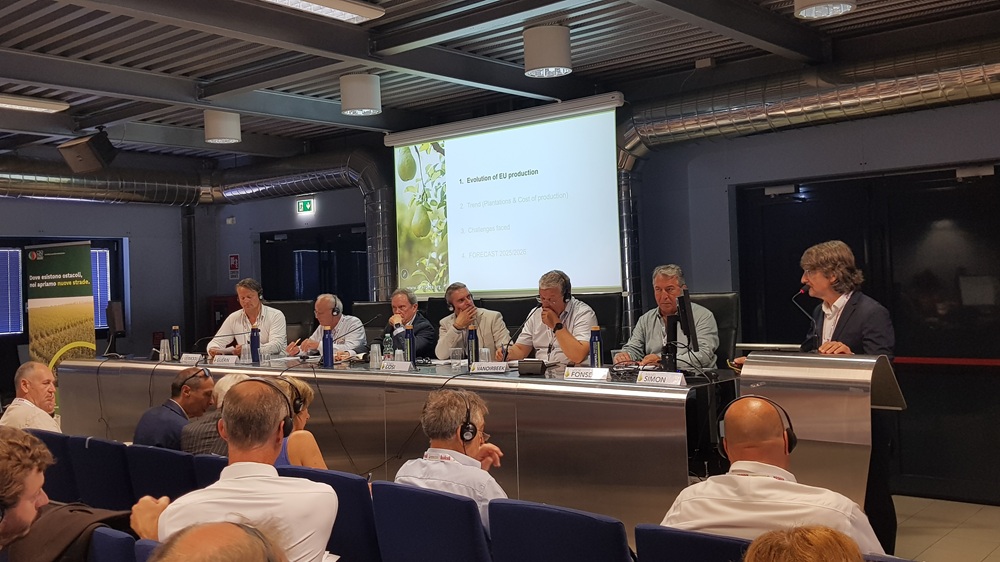
Elisa Macchi, director of CSO Italy, highlighted the decline in production across the European Union. Indeed, ten years ago, European production potential stood at around 2.4 million tonnes; by 2025, production had stabilised at around 1.8 million tonnes, due to a reduction in cultivated areas and difficulties linked to climate, plant diseases and the increasing complexity of management.
Developments in recent years also reveal a shift in the balance of power among producing countries. Until 2018, Italy played a very significant role on the European stage; after 2018, the geography of production diversified, with Belgium and the Netherlands gaining ground. Italian production in 2025 stood at around 293,000 tonnes, down by approximately 27 per cent on the previous year and a far cry from historical levels, when the national average exceeded 700,000 tonnes.
On the trade front, Elisa Macchi emphasised that, despite the decline in supply, exports to Europe had fallen only moderately. She also highlighted the growing international focus of certain countries, as well as the differences in their ability to establish a presence in foreign markets. Export propensity does indeed vary considerably: the Netherlands 86 per cent, Belgium 85 per cent, Poland 97 per cent, Portugal 58 per cent, Spain 38 per cent, whilst Italy stands at 14 per cent, largely due to the greater importance of its domestic market.
Presentations throughout the conference highlighted the challenges facing the sector in the six main EU-producing countries: generational renewal, crisis management, plant protection, adapting the production system to climate change, orchard productivity and labour costs.
To conclude the day, the key messages put forward by the speakers were as follows:
• The need to boost consumption by reaching new consumers (particularly young people), whilst advocating for its inclusion in public health policies;
• The importance of research and innovation for the development of new varieties, in particular, better suited to the effects of climate change;
• The need for active ingredients to protect orchards;
• The importance of the Common Agricultural Policy, and in particular the Common Market Organisation for fruit and vegetables and the operational programmes.
Interpera 2026 brought together Italian delegates, as well as several delegations from Belgium, the Netherlands, France, Spain, Portugal, Germany, Bulgaria and more.
Organised by CSO Italy and AREFLH, Interpera received support from key partners such as UNAPera, the City of Ferrara, the Emilia-Romagna Region, and the companies Unitec, CIV, Isolcell, BPER, AgroFresh, Corteva and Natura Nuova.
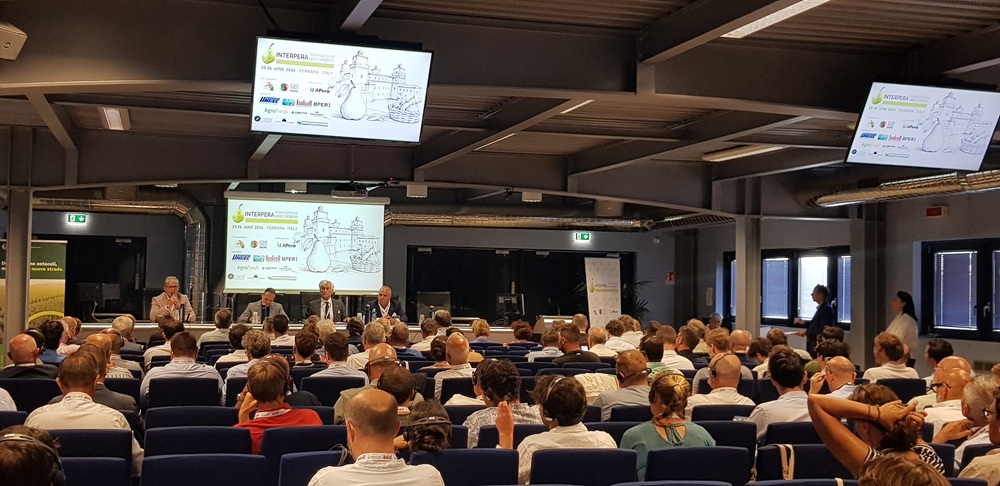
The 2026 programme
To ensure a comprehensive overview of the sector, Interpera 2026 focused around three key sessions:
- 25 June morning – Economic Session: An in-depth analysis with initial estimates for the 2026/2027 season. Market trends, consumption outlooks and new commercial development strategies will be discussed.
- 25 June, afternoon – Technical Session: A panel of international experts explored current agronomic challenges, from combating climate change to the implementation of sustainable farming techniques, right through to innovation beyond just plant varieties.
- 26 June – Technical Visits: A day dedicated to the ‘field’, with guided tours of leading local producers to experience the innovation and quality of the pear production, organised by Fondazione Navarra.
Read the 2026 programme : in English - in Italian
All information regarding the event can be found at www.interpera.org

Interpera 2025 in Belgium - workforce, climate change, consumption: the European pear sector in search of solutions
The International Pear Congress took place on 25 and 26 June 2025 in the Belgian city of Hasselt, .
This 16th edition was co-organised by AREFLH and the VBT (Federation of Belgian horticultural cooperatives).
ES : Léer el comunicado prensa en español
IT : Leggere il comunicato stampa in italiano
At today's Interpera conference, pear industry experts discussed a number of common concerns on present and the future of the sector. Many challenges are to be faced, including labour difficulties, the need to adapt farming practices in the face of phytosanitary restrictions, and water management. There is also the important issue of declining consumption, particularly among young people.
Jo Brouns, Flemish Minister of Agriculture launched the Interpera congress praising the resilience of the pear sector, and reaffirming the importance of its three pillars: research and innovation, promotion and international cooperation.
Like every year, representatives from the six main pear-producing countries - Belgium, Spain, France, Italy, the Netherlands and Portugal - gave a detailed account of the past season. On the whole, it was satisfactory for most countries, despite persistent obstacles that are increasingly complicating production conditions:
- Orchard protection, undermined by the loss of certain active molecules with no effective alternatives to replace them and fight the increasing number of diseases and pests.
- The cost of labour, and its lack of availability, hence the sector's growing interest in robotisation.
- Water management, which raises major concerns; indeed storage remains insufficient despite rainy spells, making availability irregular and difficult to anticipate.
- Falling consumption, particularly among young people. The attractiveness of the pear needs to be rethought to attract new consumers.
At the second round table of the day, the six main producing countries shared their crop forecasts for the 2024-2025 season. The following estimates should be treated with caution, as the season has not yet fully revealed its potential:
- Spain: estimated production increase of 31% compared to 2024, when production potential was not reached.
- Belgium: a 25% increase is forecast, following a downturn in the previous campaign.
- Portugal: volumes broadly stable compared to last year.
- France: expected to fall by 9%, but an increase in acreage and the arrival of new varieties should be noted.
- Italy: a possible increase, but to be confirmed later in the season, as the main Italian varieties are harvested late.
- Netherlands: initial trends point to a probable increase, following a 10% drop in the previous season.
Later in the morning Dany Bylemans, Managing Director of PCfruit, presented the work of Eufrin's 'Digital Orchards' working group, highlighting innovations such as the creation of twin digital orchards to simulate parameters, scenarios and constraints, as well as the potential of agrivoltaics.
Presentations by Kris Jans (BelOrta) and Filip Fontaine (VLAMS) detailed consumer profiles and buying habits, highlighting the fall in pear consumption over the last 20 years. Examples of good practices in marketing and promotion were presented to suggest ways of boosting consumption.
The afternoon's technical sessions explored a number of key issues for the future of pear production. Ann Schenk, project manager at the VCBT, gave an overview of post-harvest research, highlighting advances in fruit conservation and quality. Precise cultivation was also at the heart of the discussions, with a presentation by Peter Frans De Jong (Wageningen University), who illustrated how to move from the macro to the micro for fine management at tree level. Sanitary issues were also addressed: Gianfranco Anfora (University of Trento) gave a comprehensive overview of the fight against stink bugs, while Tim Beliën (PCfruit) explained how modelling can improve the positioning of control strategies against pear suckers. These presentations highlighted the research currently underway and its potential for practical application in the field.
Faced with these climatic, economic and technical challenges discussed at Interpera, Luc Vanoirbeek, General Secretary of the VBT, and Lisa Martini, Vice-President of the AREFLH, agree that "the need to get together, share ideas and innovate together has never been greater. That's the spirit of Interpera.”
Other collaborating organisations : Belorta, Boeren Bond, pcfruit, VCBT