

LivingSoiLL Beaujolais Living Lab

AREFLH is a partner of LivingSoiLL – “Healthy Soil to Permanent Crops Living Labs”, an Horizon Europe project funded by the European Commission.
This month AREFLH highlights the latest developments from the Beaujolais Living Lab (France). The opening of a soil pit in the Beaujolais experimental site was combined with a discussion session on the challenges of this vineyard area and the solutions being tested within the LivingSoiLL project. The format was direct and practical: the soil pit itself provided most of the insights.
At this site, the topsoil reaches only about forty-five centimetres. It is sandy, poorly structured, and contains at least fifty percent angular stones. It is also highly acidic. Beneath this shallow layer lies almost entirely siliceous volcanic bedrock. As a result, the soil available to vine roots is very limited, with low water-holding capacity and reduced potential to sustain biological activity.
For participants, the implications were immediately visible. On this steep slope with such a shallow soil profile, erosion is a major and ongoing risk.
Three Interventions to Address Key Soil Constraints
The session presented three management practices currently being tested at the site, all implemented in early 2026. Together, they address the main soil constraints: erosion risk, acidity, weak structure, and low biological activity.
Mulching helps protect the soil surface from rainfall and runoff, reducing erosion while improving moisture retention. It also eliminates the need for herbicide use in treated areas, contributing to lower chemical inputs.
Liming is used to correct soil acidity and increase pH. It also supplies calcium, which improves soil aggregation and enhances soil structure, leading to better infiltration and more favourable conditions for soil life.
Basalt application provides slow-release minerals that support soil microbial activity. Over time, this contributes to improved organic matter cycling and stronger soil aggregation, increasing overall soil resilience.
A Field-Based Exchange with Stakeholders
The soil pit served as a concrete starting point for discussion. Winegrowers and technical experts engaged directly with the observed conditions, exchanging views on how to manage such fragile soils in a productive viticultural context.
This practical format encouraged open dialogue between researchers and practitioners, fully aligned with the Living Lab approach of co-creation in real field conditions.
Monitoring Soil Change Over Time
Testing solutions is only the first step. A comprehensive monitoring system has been put in place to assess the effects of the interventions over time.
Alongside standard physico-chemical analyses, pesticide residue monitoring, soil DNA analysis, and bulk density measurements, a series of field tests—including spade tests, slake tests, and Beerkan infiltration tests—will assess changes in soil structure. Earthworm counts and tea bag index measurements will be used to track biological activity.
Grape development is also being monitored, including must analyses, to ensure that the practices tested do not negatively affect yield or quality.
This multi-level monitoring approach reflects the scientific rigor of the LivingSoiLL project, where observation and intervention are always supported by evidence.
A Living Soil Under Pressure
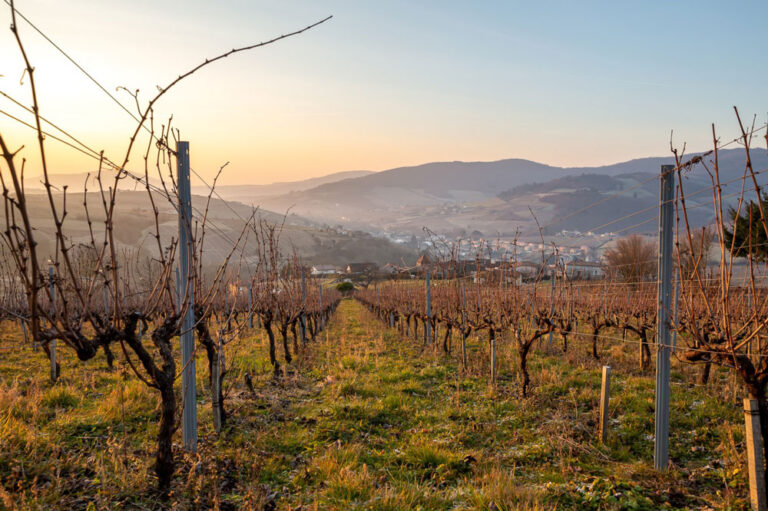
Beaujolais vineyards are known for producing distinctive wines, but the same geological features that define this landscape also make it fragile: steep slopes, ancient volcanic bedrock, and shallow, stony soils.
Through the Living Lab approach, the project aims to identify practical and science-based solutions to protect and improve these soils, in close collaboration with local winegrowers.
The soil pit opened on 18 March may have been a small intervention, but it revealed important insights and sparked meaningful discussion—contributing to a broader effort to ensure that these soils remain healthy, productive, and resilient for the future.
Know more about the project
-
Website : livingsoill.eu
-
Instagram : @LivingSoiLL
- Join the Community of Practice by filling this questionnaire (6 languages available)
-
You an also read all previous articles written by AREFLH on this project here

This project receives funding from the European Union’s Horizon Europe Research and Innovation Programme under Grant Agreement Nr. 101157502.